
Technology
Why Your iPhone Needs a Smarter Power Strategy: The Science of Staying Charged Anywhere


A smartphone rarely runs out of battery at a convenient moment. It usually happens when someone is following unfamiliar directions, waiting for an important business call, recording a special moment, or trying to complete a payment. The problem is not always that the battery is too small. Often, it is that modern phone usage has become unpredictable while charging opportunities remain limited. This is why choosing a dependable portable iPhone charger is increasingly about maintaining access to power rather than simply adding another accessory to a bag.
The deeper issue is that people use their phones in environments where traditional charging habits do not work particularly well. A wall adapter is useful at home, but less practical during a walking tour, a long commute, or an outdoor event. A car charger helps while travelling by road, yet offers little assistance when someone spends several hours away from a vehicle. Even wireless charging stands, despite their convenience, depend on having a suitable surface and a nearby power source. Different situations demand different solutions.
Understanding this challenge requires looking beyond battery percentages and advertised charging speeds. Charging technology involves energy conversion, electrical compatibility, temperature, battery behaviour, and the way people move throughout the day. Once these factors are understood, it becomes easier to build a charging system that is efficient, portable, and suited to real-world habits.
Why Battery Management Is More Complicated Than It Looks
A battery percentage is a useful indicator, but it does not tell the complete story of how much power a phone will need before the next charging opportunity. Two users can begin the morning with the same battery level and experience completely different results by lunchtime.
Consider someone who primarily reads messages and checks occasional notifications. Their phone may use relatively little energy. Another person might spend the same morning navigating through a city, taking photographs, attending video meetings, and using mobile data. The second person creates a much heavier workload, even though both devices display the same starting percentage.
Several systems contribute to this difference.
- Display activity: Large, bright screens require energy, particularly during extended use.
- Mobile connectivity: Searching for a stable network or maintaining demanding connections can increase consumption.
- Location services: Navigation and location-dependent applications can keep several systems active.
- Processing demands: Video recording, gaming, editing, and intensive applications require additional computing power.
- Background activity: Synchronisation, notifications, and application updates may continue when the screen is off.
The important lesson is that battery management should reflect behaviour, not just device specifications. Someone who frequently uses navigation needs a different charging routine from someone who spends most of the day at a desk.
The Difference Between Having Power and Accessing It
Electricity is widely available, but convenient access to it is not guaranteed. This distinction explains why portable charging has become an important part of everyday technology.
At home, a person can connect a phone to a wall adapter and leave it charging. In an airport, however, available sockets may be occupied or positioned far from comfortable seating. During a conference, the phone may need to remain in use throughout several sessions. On a road trip, charging opportunities may depend on the vehicle and the length of each stop.
These situations reveal a problem that battery capacity alone cannot solve. A device needs energy at the same time that its owner needs to use it.
A practical power strategy creates several opportunities to recharge. A wall adapter can handle overnight charging, a compact battery can provide flexibility during the day, and a vehicle adapter can support longer journeys. The goal is not to carry every possible accessory. It is to choose a small combination that covers the situations most likely to interrupt normal phone use.
How Charging Technologies Solve Different Problems
Not every charger transfers energy in the same way. Some rely on a physical connection, while others use wireless induction. Certain accessories prioritise compactness, whereas others focus on powering multiple devices.
Understanding these differences helps prevent purchases based entirely on marketing claims.
Wired Charging and the Importance of Power Delivery
Wired charging remains one of the most straightforward ways to replenish a smartphone battery. A cable creates a direct connection between the power source and the device, allowing compatible equipment to deliver energy efficiently.
USB-C has become especially important because it supports modern charging standards and provides a reversible connector. However, USB-C describes the physical connection, not the actual charging speed. A charger can have a USB-C port without supporting every advanced charging feature.
USB Power Delivery, or USB PD, allows compatible devices and chargers to negotiate suitable power levels. This means the phone can request an appropriate amount of energy instead of receiving an uncontrolled maximum output.
The cable matters as well. A low-quality or unsuitable cable can limit charging performance, even when the adapter itself is capable of delivering more power. For this reason, a charging setup should be considered as a complete system rather than a collection of unrelated specifications.
Wireless Charging and the Problem of Alignment
Wireless charging removes the need to connect a cable directly to the phone. It uses electromagnetic induction, transferring energy between coils inside the charging accessory and the receiving device.
This technology is convenient for people who regularly place their phones on desks, bedside tables, or charging stands. Magnetic alignment can make the experience more reliable by helping the charging coils remain correctly positioned.
However, wireless charging is not automatically faster or more efficient than wired charging. Energy losses, heat, alignment, case materials, and the supported charging standard can affect performance. A magnetic accessory should not be assumed to support every wireless charging feature simply because it attaches to the phone.
Battery Packs and Independent Energy Storage
Portable battery packs solve a different problem. Instead of requiring access to a wall outlet, they store energy internally and make it available whenever needed.
Their practical value depends on several factors. Capacity indicates how much energy the battery can store, while output specifications help determine how quickly it can supply energy to a connected device. Size and weight influence whether someone will actually carry it regularly.
A larger battery is not always the best choice. A traveller spending several days outdoors may appreciate additional capacity, while someone commuting between home and an office may prefer a lightweight model that fits easily into a pocket or small bag.
Why Different Charger Types Matter More Than Their Names

The charging market includes a wide range of designs, and understanding their intended purpose is more useful than memorising product categories.
For example, a standard wall adapter is designed to connect directly to an electrical outlet. A multi-port adapter can charge several compatible devices from one power source. A car charger uses a vehicle’s electrical system, while a wireless charging pad transfers power without a direct cable connection. Battery packs offer stored energy that can be used independently of an outlet.
These distinctions are particularly relevant when choosing equipment for a multi-device lifestyle.
Someone carrying an iPhone, wireless earbuds, and a tablet may benefit from a multi-port adapter at a workstation. A person who spends much of the day outside may find a portable battery more valuable. A driver who relies on navigation could benefit from a dedicated vehicle charging solution.
Readers who want to understand the broader technology landscape can explore Anker’s guide to types of chargers, which discusses the different charging options and their common applications. Knowing what each design is intended to do makes it easier to select accessories based on actual requirements rather than appearance.
The Hidden Role of Heat in Charging Performance
Charging speed receives considerable attention, but temperature deserves just as much consideration. Batteries operate within certain temperature limits, and excessive heat can affect charging behaviour and long-term battery health.
Heat can come from several sources. Fast charging generates some heat during energy transfer. Intensive phone use adds further thermal load, particularly when the display, processor, and network connection are active. Direct sunlight, hot vehicle interiors, and poorly ventilated surfaces can make the situation worse.
This explains why a phone may reduce its charging speed when it becomes too warm. Such behaviour is generally a protective measure rather than evidence that the charger has suddenly stopped working.
Good charging habits can help manage unnecessary heat:
- Avoid leaving a charging phone in direct sunlight.
- Do not cover the phone or charger with thick materials during charging.
- Reduce demanding activities when the device is already warm.
- Use compatible accessories from reliable manufacturers.
- Keep the charging area reasonably ventilated.
A charger should not be judged exclusively by how quickly it raises the battery percentage. Consistent performance and sensible temperature management are equally important.
Why Advertised Capacity Does Not Equal Actual Charging Results
One of the most misunderstood aspects of portable batteries is the relationship between advertised capacity and the amount of energy that reaches a phone.
A battery pack may display a capacity measured in milliampere-hours, commonly written as mAh. However, this figure does not represent a guaranteed number of full phone charges.
Internal battery voltage, conversion efficiency, output voltage, cable resistance, wireless transmission losses, and operating temperature all influence the amount of usable energy. Some energy is lost when the battery pack converts its stored power into an output suitable for the connected phone.
This is why two battery packs with similar advertised capacities may deliver different real-world results.
A more useful comparison considers the complete specification. Look at the stated energy capacity in watt-hours when available, output profiles, supported charging protocols, and manufacturer information about expected performance. Also consider the phone’s own battery capacity and the conditions under which charging takes place.
The practical question is not simply how many mAh a product advertises. It is how much useful charging time it can provide under the conditions in which it will actually be used.
Designing a Charging Routine Around Everyday Movement
A good charging setup should fit naturally into a person’s routine. If an accessory is too heavy, complicated, or inconvenient, it may remain at home when it is needed most.
A useful approach is to divide daily activities into different charging environments.
At Home
Home charging is best treated as the foundation of the routine. A suitable wall adapter and reliable cable can handle regular charging without requiring a portable battery to remain connected every night.
Keeping the charging area organised also reduces cable damage and makes it easier to use the correct adapter for each device.
At Work
A desk setup should prioritise convenience and compatibility. A suitable adapter can support a phone and other personal devices, while a charging stand can make it easier to keep the phone accessible.
For people who attend frequent meetings, a small battery pack provides additional flexibility when moving between rooms or working away from their usual desk.
During Travel
Travel introduces uncertainty. Delays, long journeys, unfamiliar locations, and extended use of navigation can all increase the demand for power.
A compact battery pack can provide independence from public charging points. Before leaving, it is sensible to check that the battery pack itself is charged, the cable is compatible, and the accessories are easy to access.
Outdoors
Outdoor use requires attention to environmental conditions. Direct sunlight can increase device temperature, while dust, moisture, and physical movement may affect the durability of charging accessories.
A suitable protective case and a secure charging arrangement can make the setup more practical. Wireless accessories should also be checked for compatibility with the case, since some designs can interfere with proper alignment.
What to Check Before Buying a Charging Accessory
A product description can contain impressive numbers, but those figures are useful only when they match the intended device and usage pattern.
Before purchasing, consider the following factors:
Device compatibility: Confirm the iPhone model, connector type, and supported wireless charging standards. Older Lightning models and newer USB-C models may require different cables.
Power output: Check the charger’s supported output and whether it provides the charging protocol required by the phone.
Capacity: Choose a battery size that reflects how long the phone normally stays away from an outlet. Avoid paying for unnecessary capacity if portability matters more.
Port selection: Consider whether one connection is sufficient or whether multiple ports would help charge additional devices.
Dimensions and weight: A battery pack that is difficult to carry may not become part of a daily routine.
Safety and certification: Look for reputable manufacturers, clear product specifications, appropriate safety protections, and relevant certification information.
Charging convenience: Consider whether a cable, magnetic attachment, charging stand, or multi-port adapter best suits the environment.
A well-matched accessory is usually more valuable than the product with the largest capacity or highest advertised wattage.
The Future of Personal Charging Is About Flexibility
Charging technology continues to evolve, but the most meaningful improvements are not necessarily about making every charger faster. Greater convenience, better compatibility, improved thermal management, and more adaptable designs can have a significant effect on everyday use.
USB-C has helped simplify connections across many modern devices. Wireless standards continue to develop, while magnetic charging designs make it easier to position compatible phones and accessories. Battery packs are also becoming more versatile, with different capacities, integrated cables, multiple outputs, and compact designs serving different needs.
Another important development is the growing expectation that people should be able to charge several devices without carrying a separate adapter for each one. This encourages more practical charging ecosystems built around shared standards and compatible accessories.
Still, technology cannot eliminate the need for sensible decisions. A powerful charger will not solve every battery problem if the cable is unsuitable, the phone overheats, or the accessory is incompatible. Better results come from understanding how the entire system works.
Conclusion
Reliable smartphone charging is no longer just about finding an electrical outlet. It is about maintaining access to energy across changing environments, different workloads, and unpredictable schedules. Wired adapters, wireless charging systems, vehicle chargers, and portable battery packs each have a role, but their usefulness depends on how well they match a person’s daily activities.
The smartest approach is to build a simple, compatible setup that balances portability, capacity, charging performance, and safety. Once charging decisions are based on real needs rather than impressive specifications alone, it becomes much easier to keep an iPhone ready for the moments when it matters most.
Frequently Asked Questions
What should I look for in a portable charger for an iPhone?
Check compatibility with your iPhone model, battery capacity, output power, supported charging protocols, dimensions, and safety features. The best choice depends on how often you travel and how much additional battery life you normally need.
Is a USB-C charger suitable for every iPhone?
No. Newer iPhone models use USB-C, while older models may use Lightning. Always check your device’s connector and choose the appropriate cable and compatible charging adapter.
Is wireless charging better than wired charging?
Neither option is universally better. Wired charging is often more efficient and can offer higher charging speeds with compatible equipment. Wireless charging provides convenience by removing the need to connect a cable directly to the phone.
Does a higher-capacity power bank always provide more phone charges?
Not necessarily. Conversion losses, output voltage, temperature, and charging efficiency affect how much stored energy reaches the phone. Advertised capacity should be considered alongside practical output specifications.
Can using a fast charger damage an iPhone battery?
A compatible, reputable charger does not automatically damage an iPhone simply because it supports a higher maximum output. The phone manages the power it accepts. Excessive heat and poor-quality accessories are more important concerns, so choosing suitable equipment and maintaining reasonable charging conditions is essential.

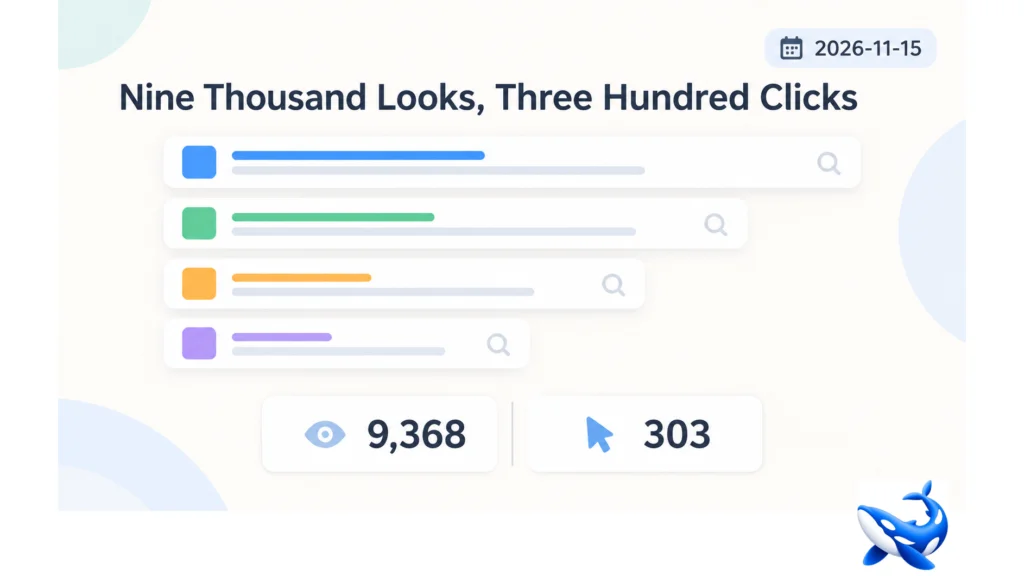
Of the eleven model names OrcaRouter serves on its cyber tier, the Qwen abliterated API attracts among the most search demand on the whole shelf [OURS].
Four Qwen queries drew 9,368 impressions and 303 clicks in the four weeks to 2026-11-09 — a 3.2% click-through rate. The strongest of them sits at position 4.6 and still converts one in fifty impressions.
That gap between ranking and clicking is the subject here, and the answer is not the snippet. It is a single specification row that every one of those searchers is about to discover the hard way.
The four queries
| query | impressions | clicks | CTR | position |
| qwen uncensored | 4,833 | 224 | 4.6% | 5.0 |
| qwen 3.8 uncensored | 2,053 | 31 | 1.5% | 10.3 |
| qwen abliterated | 1,812 | 36 | 2.0% | 4.6 |
| qwen 3.8 flash next abliterated | 670 | 12 | 1.8% | 6.9 |
[OURS], Google Search Console, 2026-10-12 → 2026-11-09.
Two of these are position-5 queries with 1.5–2.0% click rates, which is roughly a quarter of what a position-5 result normally earns. That is the signature of a result whose snippet does not answer the question being asked, and the question being asked is almost certainly “is it free, and where do I call it”.
The third and fourth rows are the ones that matter commercially: “qwen abliterated” and “qwen 3.8 flash next abliterated” are people who already know what they want and are looking for an endpoint. Combined they are 2,482 impressions and 48 clicks.
What those searchers are about to find
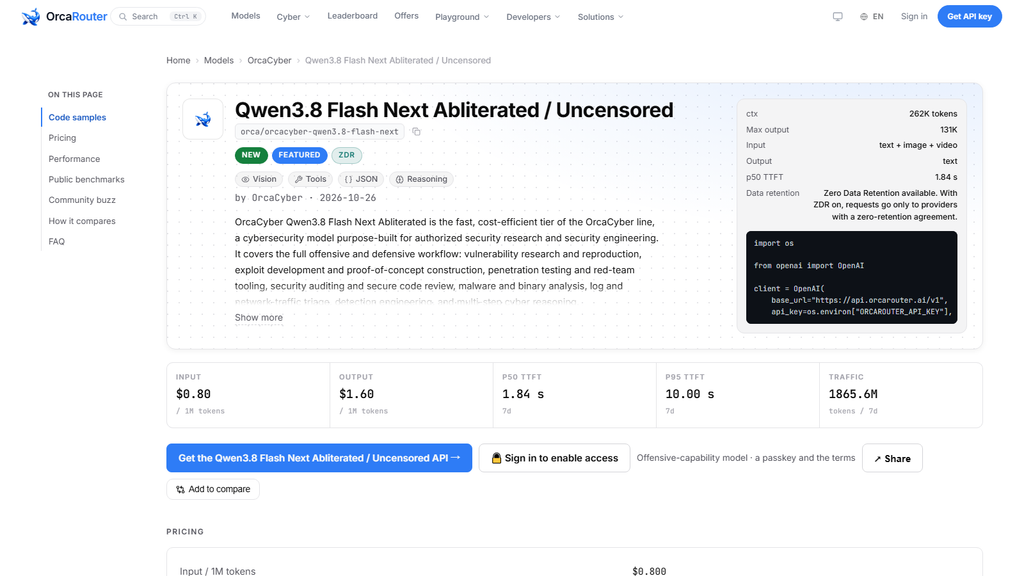
The card is called Qwen3.8 Flash Next Abliterated / Uncensored, priced at $0.80 in and $1.60 out, and it accepts text, image and video [OURS].
Its context window is 262,144 tokens.
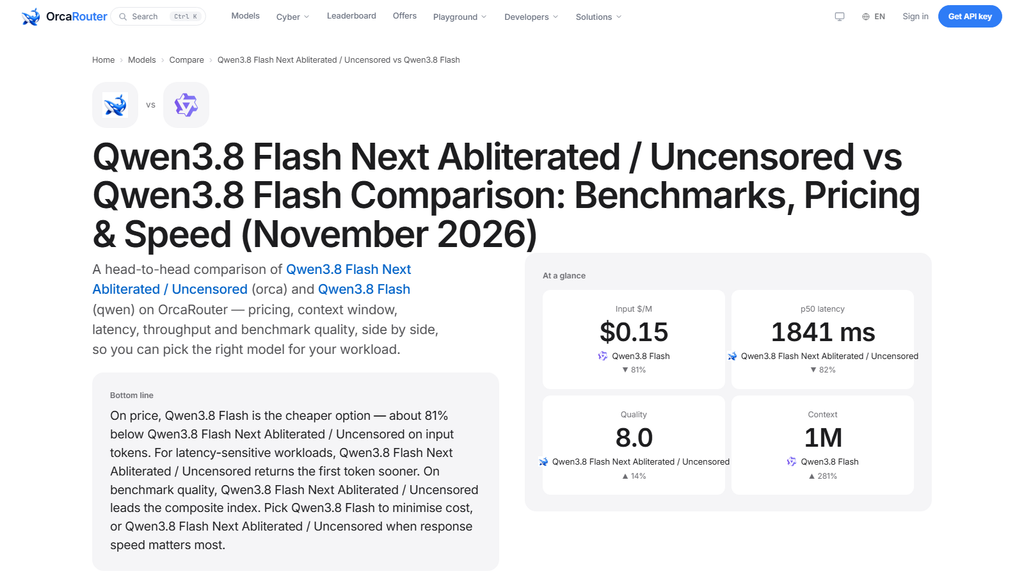
That is the row. Every other abliterated card on the tier — DeepSeek, GLM 5.3 Flash, MiMo, MiniMax, Hy4 — offers at least 262,144 and five of them offer 1,048,576. The base checkpoint this card was built from offers 1,000,000 [OURS].
So a team that arrives from “qwen 3.8 flash next abliterated” expecting the Qwen they know is getting a quarter of the window. Not a slower model, not a weaker one — a smaller one, at the same price as the cards around it that are four times larger.
That is worth knowing before an integration, and it is not on the snippet.
Why the window shrank
The card is 262,144 and the checkpoint is 1,000,000. A 74% reduction is not an artefact and it is not a documentation error; it is the shape of the abliterated build.
The likely cause is serving economics. A 1,000,000-token window is expensive to keep resident, and a catalogue that offers both a general checkpoint and a specialised card will often provision the specialised one smaller so that its price can stay competitive. Qwen’s card sits at the tier’s standard $0.80/$1.60, and holding a million tokens at that price is a different commercial proposition from holding a quarter of it.
The same pattern appears twice more on the tier: MiniMax M3.1 Flash is a quarter of its base on both context and output ceiling, and Hy4’s base carries a 64,000-token ceiling against the card’s 65,536. Small windows on abliterated builds are the norm rather than the exception.
What is unusual is that Qwen’s base is the largest on the tier. A million tokens dropping to a quarter is the biggest single shrink here in absolute terms.
What a quarter of a million tokens holds
Concretely, and it is more than it sounds.
A 200,000-token repository — a mid-sized monorepo, a large service, a well-commented codebase. Fits with room for a question.
Fifty long documents at 5,000 tokens each. A full case file.
A four-minute video at one frame per second, or twenty minutes at one frame every five seconds [OURS, our approximation].
A week of logs if you sample rather than ingest everything.
What it does not hold is the thing the million-token cards are sold for: an entire large repository plus its history plus the incident, in one call. A team doing repository-scale audit work will hit the ceiling on the first attempt and will be chunking by the second week.
The protocol surface, which is the card’s real argument
Seventeen parameters, all three endpoint shapes — chat-completions, Responses and Messages — with ZDR available and a 1,838 ms median [OURS].
That combination is rarer than it sounds. Six of the eleven cards are chat-only; Qwen is one of five that speaks all three. For a team standardising on one client shape and routing across the tier, that is the difference between a card that fits the integration and one that needs a special case.
Its serving rows are also strong: 94.0 output tokens a second, third fastest in the tier, and 0.603% errors, third lowest [OURS]. Neither is the best, and both are comfortably above the middle.
So the card is well equipped and slightly small. That is a coherent product, and it is not the one the search queries describe.
The traffic confirms it
1.86 billion tokens in the seven days to 2026-11-15 — second lowest on the abliterated side, and a nineteenth of DeepSeek’s 32.99 billion at the same price [OURS].
Nine thousand searches a month for Qwen abliterated and 1.86 billion tokens a week of usage is not a mismatch. It means the searchers arrive, look at the window, and most of them choose a different card.
The two quiet cards on the abliterated side are Qwen and MiniMax, and both have 262,144-token windows. The six loud cards all have at least 262,144 and five have a million. That correlation is not proof and it is the cleanest explanation in the data.
The base checkpoint’s own traffic makes the same point from the other side: 4.00 billion tokens a week against a window four times larger, at a fifth of the card’s price, before you even reach the abliterated build.
How to choose, given all of it
Three questions, in order.
Does your prompt exceed 262,144 tokens? If yes, this is not your card — take GLM 5.3 Flash or MiMo at a million, at the same price. If no, the window costs you nothing and the card’s protocol surface and serving rows are the argument.
Do you need all three endpoint shapes? If you are standardising a client across the tier, Qwen is one of five cards that will not need a special case. That is worth real engineering time.
Do you need video? Five cards take it and Qwen is one. If video is on your roadmap and your prompts are small, it is a reasonable single-card answer.
The card is a good fit for a team with short prompts, a standard client and a video requirement. That is a narrower group than the search volume suggests, and it is the group the card is actually built for.
The short version
9,368 impressions and 303 clicks across four Qwen queries, at positions that should convert far better than 3.2%. The reason they do not is a 262,144-token window on a card whose base offers a million.
The card is genuinely good on every other row — 94.0 tokens a second, 0.603% errors, all three endpoint shapes, ZDR — and its traffic is 1.86 billion tokens a week, which is what a good card with a small window looks like.
Check your prompt size first. Under 262,144 tokens the window costs nothing and the protocol surface is worth having; above it, five cards at the same price will do the job.
Sourcing note: search impressions, clicks, CTR and positions are OrcaRouter’s own Google Search Console data for 2026-10-12 → 2026-11-09 [OURS]. Context windows, output ceilings, prices, parameter surface, endpoint types, ZDR flag, latency, throughput, error rates and traffic are read from the eleven cards’ public model data on 2026-11-15, with seven-day windows ending that day [OURS]. Frame-budget arithmetic is our own approximation. No benchmark rows are quoted.


A missing DLL file or game launch error can prevent your favorite PC games from opening properly, ruining your gaming experience. These issues can occur due to outdated, corrupted, or missing drivers and essential system components. Fortunately, Driver Booster offers a convenient way to identify and update outdated drivers that may contribute to these problems. Instead of manually searching for compatible driver versions, users can scan their PCs and install available updates with just a few clicks. In this guide, we will explore how Driver Booster can help solve game launch errors and missing DLL files in Windows 11 and improve gaming performance.
Part 1: Common Reasons Behind Game Launch Errors and Missing DLL Files
There are several reasons for game launch errors and missing DLL files in Windows 11. Below, we have highlighted some common reasons why your favorite PC games might fail to launch or display missing DLL file errors:
- Outdated Graphics Drivers: One of the most common causes is outdated or incompatible graphics drivers.
- Missing DLL Files: Games rely on specific DLL files to perform essential functions. If these files are missing or corrupted, the game may fail to start.
- Corrupted Game Files: Incomplete downloads, interrupted installation, or accidentally deleted files can damage game installations and trigger launch errors.
- Outdated Windows Components: Running an outdated version of Windows 11 can sometimes create compatibility issues with newer games.
Part 2: What is Driver Booster?
If you are looking for a simple way to fix game launch errors and missing DLL files in Windows 11, IObit Driver Booster can be a helpful solution. It is a driver management tool designed to scan your PC, identify outdated, missing, and faulty drivers, and update them to the latest version without any manual effort. In addition, Driver Booster offers amazing tools that can fix multiple game-related issues, such as missing DLL files. Fix Missing Game DLLs feature scans automatically, identifies, and repairs missing DLLs and game components. It supports 680+ DLLs and 60+ game components. Plus, it also includes Real-Time DLL Detection to detect missing DLLs and provide pop-up alerts with one-click repair.
Part 3: Key Features of Driver Booster

Driver Booster offers several useful features that can help fix game launch errors and missing DLL files while improving overall PC performance. Below, we’ve listed the top features of this driver updater:
- Fix Missing DLL Files Error: Driver Booster includes a dedicated Fix Missing Game DLLs feature that automatically scans your system to detect missing or problematic DLL files. It supports more than 680 DLL files and 60 game components, helping users resolve common errors that prevent PC games from launching.
- Automatic Driver Updates: Another amazing feature of Driver Booster is that it enables users to automatically update missing, corrupted, or faulty drivers to the latest version without any manual effort, helping users fix common issues like game launch errors on Windows 11.
- 23 Million+ Drivers: One of the standout features of this tool is that it supports over 23+ million drivers from 1200+ brands, including Dell, HP, Lenovo, Brother, AMD, Intel, Logitech, Canon, Realtek, Song, Samsung, LG, MSI, Microsoft, ASUS, NVIDIA, and TP-Link.
- Multi-Version Scanning: The latest Driver Booster equips a brand-new scanning engine and a revamped installation core. It supports multi-version driver scanning and detection, allowing users to identify different available driver versions for their installed hardware. This makes it easier to find suitable updates.
- User-Friendly Interface: Driver Booster offers an intuitive interface, which enables users to download and update drivers without technical knowledge. This makes Driver Booster ideal for non-tech and beginner users, allowing them to update drivers without professional help.
Part 4: How to Fix Game Launch Error and Missing DLL Files in Windows 11 Using Driver Booster
Driver Booster enables users to fix game launch errors and missing DLL files in Windows 11 with a single click. Here is how to do it:
- Go to the IObit official site and download the latest version of Driver Booster for your PC. Install and launch it. Next, select the “Tools” option from the left panel. Multiple tools will appear on your screen, including “Fix Missing Game DLLs,”

- Click on the “Fix Missing Game DLLs” option. Next, click on the “Scan” button to start the process and let Driver Booster examine your system. Once the scan is complete, the program will display the detected missing DLL files and game components.

- Click the “Fix” option to allow Driver Booster to repair the detected issues. The program will automatically handle the repair process for supported components, eliminating the need to search for and install individual DLL files manually.
Part 5: FAQs Related to Driver Booster
- How to Update Drivers Using Driver Booster?
Simply launch the program on your PC and click on the “Scan” button. Once the scanning process is complete, click on the “Update Now” button to install the latest version of the drivers.
- Is Driver Booster Free to Use?
Yes, Driver Booster offers a free version, allowing users to update drivers to the latest version without spending a single penny.
Final Thoughts
Game launch errors and missing DLL files can be irritating, especially when you are excited to play your favorite PC games. Fortunately, IObit Driver Booster offers a convenient way to troubleshoot these issues through its dedicated Fix Missing Game DLLs feature.


The digital world has brought about new methods of people and businesses sharing ideas, introducing products, and building online communities. A fast-growing trend is the AI influencer, a virtual human character who uses AI along with creative design to produce content and connect with audiences on social media platforms. Different from regular content creators, these characters are created using a mix of artificial intelligence and a creative design process. In addition to their use in creating content and interacting with customers through product promotions or entertainment, they can also be used in lifestyle pictures, fashion videos, etc. With innovative tools at our disposal such as Dreamina, digital artists or designers can come up with several concept variations and character designs. As a result, one of the areas where this change has taken off is telling digital stories and setting up online brands.
The Concept of Virtual Content Makers
The virtual content maker is a digital figure that has its own look, preferences, and way of communication. It might be presented as fashionistas, tech lovers, or even travel junkies who will be a major influence in fitness, lifestyle, and other niche markets. The persons or companies who launch them handle all their online activities. Every picture, caption, and clip has been put together to reflect the characteristics of the figure. Thus, they present a channel to creators who can build a well-recognized online identity without having to rely on traditional photo sessions or human spokespersons.
AI Influencers’ Future Prospects
As creative technology becomes more advanced, we can see a future in which digital characters become highly interactive. Advancements such as more realistic animation, better voice synthesis, and higher-quality video editing technologies enable virtual personalities to engage people more actively through various forms of digital content, not only videos or images. In fact, marketing departments of large companies might be using virtual characters in their ads, online stores, and even learning sessions for customers. These kinds of scenarios would generate fresh opportunities and revenue for creators as well as marketers.
Conclusion
Faster development in AI technology is opening new channels for digital content creators and brands to interact with or reach audiences via social media. Using AI to create a digital character that the user can interact with not only enhances the experience for the creator but also gives the business opportunities for their promotion online in a way different from what they have been doing through the years. The ability to generate unique content through such characters can lead to the launch and sharing of stories and, of course, the showcasing of products. At the same time, it’s worth saying that one can’t build a successful virtual influencer just by acquiring cutting-edge technology and having a cool idea.
The role/character should have a clear niche (something that differentiates it from others, a kind of personality), always look and act the same (in other words, there shouldn’t be a sudden change in appearance from one day to another, which would probably confuse the audience and lead to a loss of their interest), provide content that is of some value to the audience, and make the audience feel the authenticity of the interaction through honest communication and responses. In conclusion, a virtual creator or a digital character can only be a meaningful and long-lasting asset for the content creators and marketers if the user’s interests and the needs of the target audience are taken into consideration when developing the character, as well as the personality is kept consistent and recognizable to the audience.
FAQs
Which social media platform is best for Virtual Influencers?
Instagram, TikTok, and YouTube are widely used as well. As you can imagine, the main factor that determines what social network to use will be the character’s niche, the kind of content that you plan to produce, and the group of consumers that you have in mind.
Can an AI influencer be profitable?
Indeed, an AI influencer has the potential to be monetized. Ways of making money might be sponsorships, affiliate marketing, brand partnerships, licensing, and digital products. The result is determined by the level of audience interaction and presence in the market for products and services.

Why Regular AC Maintenance Keeps Your Home Cool and Costs Low

Why ProStar Garage Doors Is the Smart Choice for Your Next Garage Door Installation

Crickets Taking Over Your Home? Here’s What Actually Works

Nancy Simon: Meet Neil Simon’s Daughter and Woody Harrelson’s Ex Wife

Who Was Russell Derek? Inside The Life of John Derek’s Son

Steven Fleischmann: Inside the Love Story of Erin Moran and Her Husband
-
 Celebrity2 months ago
Nancy Simon: Meet Neil Simon’s Daughter and Woody Harrelson’s Ex Wife
-
 Biographies5 months ago
Who Was Russell Derek? Inside The Life of John Derek’s Son
-
 Biographies4 months ago
Steven Fleischmann: Inside the Love Story of Erin Moran and Her Husband
-

 Biographies5 months ago
Who is Kassidy Duhamel? All About the Life of Josh Duhamel’s Sister
-

 Biographies5 months ago
Micah Emmanuel Lanfer: All About the Life of Sarah Drew and Peter Lanfer’s Son
-

 Biographies5 months ago
Who is Bear Beghe? All About the Life of Jason Beghe’s Son
-

 Biographies5 months ago
Caleb Michael Jackson: The Untold Story of Lisa Vultaggio and Jonathan Jackson’s Son
-

 Biographies4 months ago
Mackenzie Stiles: The Real Story of Ryan Stiles’ Daughter